How Do I Remove Coffee Stains From Marble?
How Do I Remove Coffee Stains From Marble?
Coffee tannins bind quickly to marble's open pore structure. Dush Alka Cleaner — an alkaline stone cleaner — is the correct chemistry to lift this staining safely, without etching the surface.
A coffee cup left on a marble countertop for even a few minutes can leave behind a brown ring that seems to set in almost instantly. The good news is that coffee staining, unlike some other marble stains, responds well to the correct cleaning chemistry — provided you reach for the right product rather than the instinctive reach for lemon or vinegar.
To remove coffee stains from marble: blot the spill immediately with a dry cloth without rubbing, then clean with Dush Alka Cleaner, an alkaline stone cleaner that lifts coffee's tannin pigment without etching the marble. Apply generously, allow a short dwell time, wipe with a soft cloth, and rinse with clean water. Fresh spills typically clear in a single application. Older or dried stains may need 2 to 3 application cycles, allowing the marble to dry between each.
Why Coffee Stains Marble
Coffee stains marble because it contains tannins — naturally occurring polyphenol compounds with a chemical affinity for the calcium carbonate in marble. When coffee contacts marble's open pore structure, tannins penetrate and bind to the surface and near-surface pores, creating brown discolouration. Coffee also has a mildly acidic pH of around 5, meaning prolonged contact carries a secondary risk of light surface etching in addition to staining.
Tannins and Marble — The Staining Mechanism
Tannins are large polyphenol molecules found naturally in coffee, tea, and many plant-derived beverages. They are known for their strong, persistent staining behaviour on porous surfaces — the same property that makes them used historically in dyes and leather tanning.
Once a tannin molecule enters an open marble pore, it adheres to the pore surface through a combination of physical adsorption and weak chemical interaction with the stone's mineral structure. This is generally a less aggressive bond than the chelation that turmeric's curcumin forms, which is part of why coffee staining responds well to alkaline cleaning rather than requiring an extended poultice treatment in most cases.
Coffee's pH of approximately 5 also means it sits on the acidic side of neutral. While far less aggressive than lemon juice (pH 2) or vinegar (pH 2–3), prolonged contact — particularly overnight or longer — can produce mild surface etching in addition to the staining itself, which is why prompt cleanup matters for both reasons.
Dush Alka Cleaner — How the Alkaline Chemistry Removes Coffee Stains
Dush Alka Cleaner removes coffee stains because its alkaline formulation is chemically suited to lifting tannin pigment — the compounds responsible for coffee's brown colour respond well to alkaline conditions, which help break the weak bonds holding the pigment in the marble's pores and lift it free. Crucially, this alkaline approach avoids the etching risk that acidic cleaners would introduce on marble's calcium carbonate surface, making it the correct chemistry for coffee specifically, not just a general-purpose cleaner used by default.
DUSH ALKA CLEANER
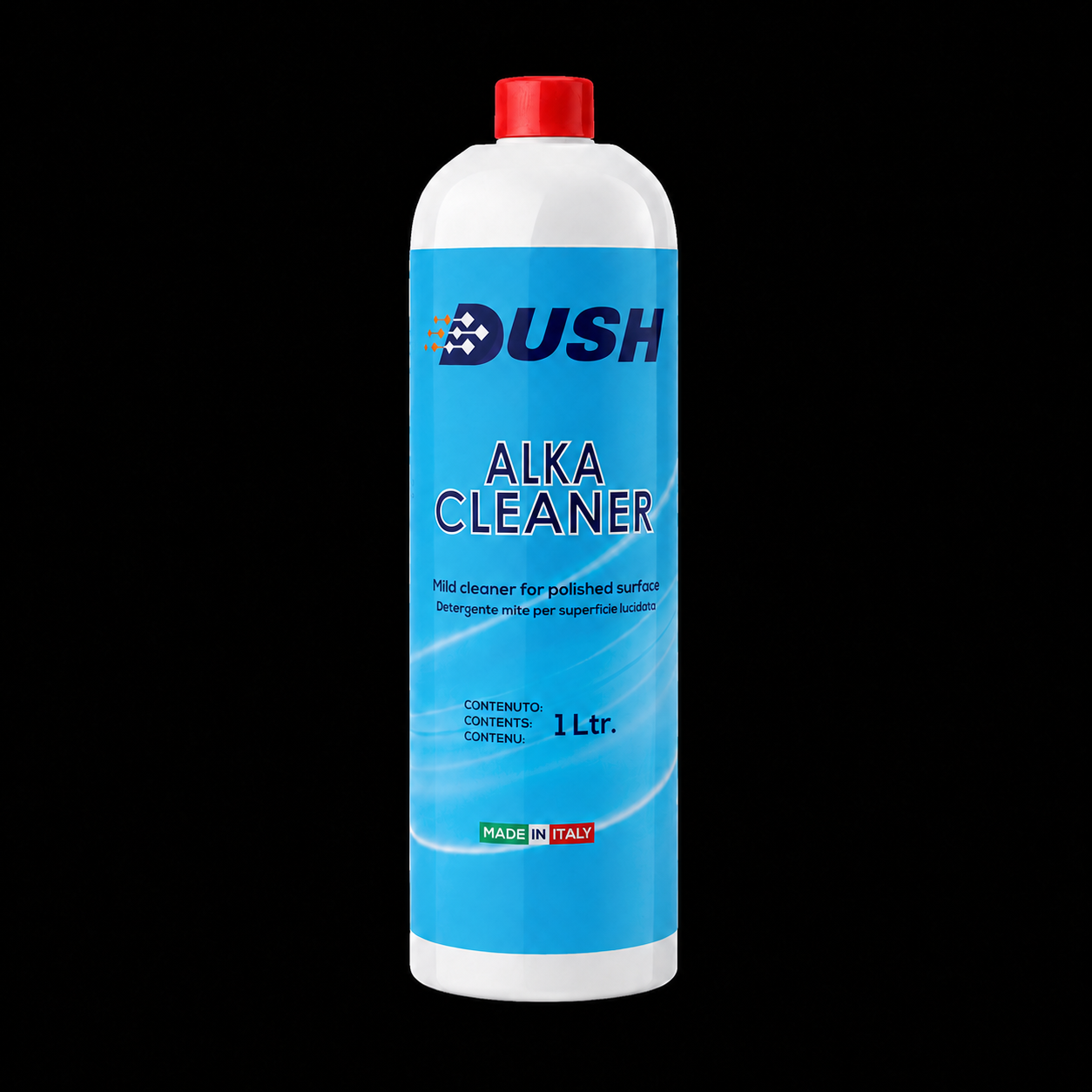
The instinctive household response to a stain is often an acidic cleaner — lemon, vinegar, or a descaling product. On marble, this is precisely the wrong direction. Acid reacts directly with marble's calcium carbonate, etching the polished surface regardless of whether it does anything for the stain itself. Coffee stains call for the opposite chemistry: alkaline.
Dush Alka Cleaner is formulated to be alkaline enough to effectively lift tannin pigment and accompanying oily residue from cream or sugar, while remaining fully safe for marble's calcium-sensitive surface. It is suitable for both white and dark marble varieties, and works equally well on granite and other natural stone surfaces that face the same coffee and tea staining in kitchens and dining areas.
- ★Targets tannin chemistry specifically: Alkaline formulation matched to how coffee and tea pigments bind to marble's pore structure
- ★No etching risk: Unlike acidic alternatives, Alka Cleaner does not react with or damage marble's calcium carbonate surface
- ★Removes accompanying residue: Lifts oily film from cream, milk, or sugar that often accompanies coffee spills
- ★Safe for polished and honed marble: Does not dull or alter the surface finish when used as directed
- ★Works on multiple stone types: Suitable for marble, granite, and other natural stone surfaces commonly used in Indian kitchens and dining areas
Fresh Spills vs Old, Dried Coffee Stains
A fresh coffee spill cleaned with Dush Alka Cleaner within a few minutes typically lifts completely in a single application. An old or dried coffee stain — one that has been present for days, weeks, or longer — usually requires 2 to 3 application cycles, with the area allowed to dry fully between treatments, since the tannin pigment has had more time to settle into the marble's pore structure.
Fresh Spill (Minutes Old)
Blot immediately with a dry cloth to absorb liquid before it spreads further into the pores.
Apply Dush Alka Cleaner, allow a brief dwell time, wipe and rinse. In most cases, the stain lifts completely in this single cycle.
Typically 1 applicationOld, Dried Stain
Tannin pigment has had time to settle deeper into the surface and near-surface pore structure.
Apply Dush Alka Cleaner, allow to work, wipe, rinse, and let the area dry fully before reapplying. Repeat 2 to 3 times as needed.
Typically 2–3 applicationsFor coffee stains that have been present for many months or years and do not respond fully to repeated Alka Cleaner treatment, the tannin pigment may have penetrated deep enough to require a poultice treatment such as Dush Stain-Ex, which works through extended 24-hour contact to draw discolouration out from deeper within the pore structure — the same approach used for severe and long-standing marble staining of all kinds.
How to Apply Dush Alka Cleaner — Step by Step
Blot the Spill Immediately
For fresh spills, blot with a dry cloth without rubbing. Rubbing spreads the coffee further into the surrounding pores rather than absorbing it. Work from the outside of the spill inward.
Apply Dush Alka Cleaner
Apply Dush Alka Cleaner generously over the entire stained area, ensuring full coverage of the visible discolouration and slightly beyond its edges.
Allow Dwell Time
Let the cleaner sit for several minutes to allow the alkaline chemistry to act on the tannin pigment. Do not allow the product to dry on the surface during this period.
Wipe and Rinse
Wipe the area with a soft, clean cloth and rinse thoroughly with clean water to remove all cleaner residue from the surface.
→ Rinsing fully prevents any cleaner residue from affecting the marble's appearance once dry
Allow to Dry and Assess
Allow the area to dry completely before judging the result — marble often appears lighter or darker when wet, which can be misleading.
Repeat if Necessary
For older or dried coffee stains, repeat the full application 2 to 3 times, allowing the area to dry fully between cycles, until the discolouration is fully lifted.
Coffee Staining vs Coffee Etching — Knowing the Difference
Coffee staining is a brown discolouration caused by tannin pigment in the marble's pores, with the surface texture and polish remaining smooth and intact. Coffee etching occurs when coffee's mild acidity, in prolonged contact, dissolves a thin layer of the surface calcium carbonate, leaving a dull, slightly rough patch in addition to or instead of brown discolouration. Dush Alka Cleaner addresses staining effectively, but cannot reverse etching, which requires professional re-polishing.
| Characteristic | Coffee Staining | Coffee Etching |
|---|---|---|
| Cause | Tannin pigment penetrating the pores | Mild acidity dissolving the surface |
| Surface texture | Unchanged — smooth, intact polish | Dull, slightly rough where dissolved |
| Appearance | Brown discolouration | Light, dull mark — may or may not be discoloured |
| Typical cause | Coffee left on surface for minutes to hours | Coffee left in contact for many hours or overnight |
| Correct treatment | Dush Alka Cleaner | Professional re-polishing required |
| Can cleaning fix it? | Yes — this is what Alka Cleaner is for | No — cleaning cannot restore dissolved polish |
Quick test: run a finger over the mark. If it feels smooth and the polish reflects light evenly, it is staining — Alka Cleaner will resolve it. If the area feels rough or the reflection looks dull and uneven compared to the surrounding surface, it is etching, and cleaning alone will not restore it.
What Never to Use on Coffee Stains
Never use lemon juice, vinegar, or any acidic cleaner on coffee-stained marble. While these are common household stain remedies for other surfaces, on marble they actively etch the calcium carbonate surface — making the problem worse, not better, and often turning a treatable stain into a stain plus permanent surface damage that requires re-polishing.
Never Use
- Lemon juice — a common but damaging household instinct
- White vinegar or any vinegar-based cleaner
- Bleach undiluted directly on the marble surface
- Steel wool or abrasive scouring pads
- Strong household descalers or rust removers
Correct Approach
- Dush Alka Cleaner — alkaline, marble-safe formulation
- Blot fresh spills, never rub
- Soft cloth and clean water for rinsing
- Repeat applications for older stains, not stronger chemicals
- Dush Densi Max Ultra — to prevent recurrence permanently
Preventing Coffee Stains in the Future
To prevent coffee stains on marble, clean spills immediately with Dush Alka Cleaner rather than letting coffee sit, and use coasters under cups and mugs on marble countertops and tables. For permanent protection, apply Dush Densi Max Ultra penetrating densifier at the next professional polishing cycle, which closes the marble's internal pore structure so coffee beads on the surface rather than absorbing into the stone, preventing staining at the source.
Cleaning up after stains is necessary, but it is treating the symptom rather than the cause. Dush Densi Max Ultra, applied at the 80-grit grinding stage during marble polishing, permanently closes the marble's pore structure from within — meaning coffee, tea, and other daily spills sit on the surface rather than penetrating, giving far more time to clean up without any staining risk at all.
For marble already installed and not due for repolishing soon, a quality impregnating surface sealer such as Dush Protek+ provides meaningful interim protection, reducing how quickly coffee and other liquids penetrate while you wait for the next professional polishing opportunity.
Need Help With a Stubborn Coffee Stain?
If repeated Dush Alka Cleaner applications are not fully resolving an older coffee stain, our technical team can help assess whether a poultice treatment or deeper intervention is needed.
Contact Technical Team →Related Dush Guides and Products
Coffee Stain Removal — Questions Answered
How do I remove coffee stains from marble?
Why does coffee stain marble?
How does Dush Alka Cleaner remove coffee stains specifically?
Can old, dried coffee stains be removed from marble?
Is it safe to use Dush Alka Cleaner on polished Italian marble?
What is the difference between a coffee stain and coffee etching on marble?
How can I prevent coffee stains on marble in the future?
External References
Remove Coffee Stains the Right Way — No Etching Risk
Dush Alka Cleaner is formulated specifically for tannin-based stains like coffee and tea, safely lifting discolouration without the surface damage acidic cleaners cause on marble.


Comments
Post a Comment