Can Yellowing on Marble Be Reversed Without Replacing the Slab?
Can Yellowing on Marble Be Reversed Without Replacing the Slab?
Most yellowed marble is treatable, not terminal. This guide explains when Dush Stain-Ex can restore the original colour, and the rare cases where replacement is genuinely the only option.
Standing in front of yellowed marble that was once pristine white, the question that comes to mind for most homeowners is whether the floor is simply ruined — whether the only real fix is tearing it out and starting again. In the overwhelming majority of cases, the answer is no. Yellowing is a treatable colour change, not permanent structural damage, and replacing the slab is rarely the necessary or sensible response.
Yes — marble yellowing can be reversed without replacing the slab in the large majority of cases. Yellowing is a colour change caused by oxidation, absorbed oil, or degraded sealers inside the marble's pore structure, not structural damage. Dush Stain-Ex, applied as a 24-hour poultice treatment, draws the discolouration out and restores the marble's original colour. Slab replacement is typically only necessary when yellowing is accompanied by separate physical damage such as cracking or severe surface loss.
The short answer is yes
Yellowing lives inside the pore structure as a chemical compound, not as a structural flaw in the stone itself. That distinction is exactly why a poultice treatment like Dush Stain-Ex can reach it and reverse it — the marble underneath the discolouration is unchanged and fully restorable.
Why Yellowing Is Treatable — Not Structural Damage
Yellowing is treatable because it is a chemical and colour-based change occurring inside the marble's pore structure, not a structural alteration to the calcium carbonate crystal matrix that makes up the stone itself. Oxidised iron compounds, absorbed oil residue, and degraded sealer chemicals are foreign substances trapped within the pores — they can be chemically broken down and physically drawn out using a poultice treatment, leaving the marble's actual mineral structure completely intact and unchanged.
This is the key distinction that determines whether a yellowed marble surface is restorable: the discolouration is something added to the stone — iron oxide, oil, sealer breakdown products — rather than something fundamentally changed about the stone. A poultice like Dush Stain-Ex works precisely because it targets and removes the added substance, not because it alters the marble itself. The crystalline calcium carbonate structure that gives marble its strength, hardness, and capacity to be polished remains exactly as it was, hidden underneath the yellow contamination, waiting to be revealed once the poultice has done its work.
This is fundamentally different from, for example, a deep crack running through a slab, or severe etching that has physically dissolved away the polished surface layer. Those are genuine structural changes to the stone — yellowing from oxidation or oil is not.
The Rare Cases When Replacement Is Actually Necessary
Slab replacement is genuinely necessary only in a small minority of cases: structural cracks running through the stone, severe pitting or spalling causing physical surface breakdown, etching damage so extensive that re-polishing would reduce the slab below safe thickness, or extensive deep staining from a source like embedded rust that has spread through the stone's structure. Pure colour change from oxidation, oil absorption, or sealer degradation — even when severe — does not require replacement.
No Replacement Needed
- Iron oxidation discolouration — yellow, amber, brownish tint
- Absorbed cooking oil causing darkening or yellowing
- Degraded topical wax or acrylic sealer yellowing
- Turmeric or other organic pigment staining
- Coffee, tea, or general organic discolouration
- Hard water mineral haze on the surface
- Even severe, decades-old yellowing — more treatment cycles, but still treatable
Replacement May Be Necessary
- Structural cracks running through the slab
- Severe pitting or spalling — physical surface breakdown
- Extensive etching that removed too much surface to re-polish safely
- Deep rust staining from embedded metal spread widely through the stone
- Slab thickness already reduced below safe structural minimum
- Damage combined with yellowing — assess each separately
The practical test: run your hand over the affected area. If the surface feels smooth and intact, and the only issue is the colour, the marble is treatable — proceed with Dush Stain-Ex. If the surface feels rough, pitted, cracked, or structurally compromised, that is a separate physical issue that needs its own assessment, independent of the colour question.
Treatment Cost vs Replacement Cost
Treating yellowed marble with Dush Stain-Ex is almost always significantly cheaper than slab replacement. Replacement involves the cost of new stone, removal and disposal of the old slab, re-installation labour, and the near-impossible task of perfectly matching colour and veining to surrounding marble from a different quarry batch. Stain-Ex poultice treatment costs a fraction of replacement and requires no removal of the marble from the floor or wall — no disruption to the surrounding installation at all.
Stain-Ex Treatment
No removal needed
No disruption to surrounding floor
No colour-matching risk
Performed in place, 24 hours per cycle
Slab Replacement
New stone purchase required
Removal, disposal, re-installation labour
Colour and veining match often impossible
Full area disruption during work
Beyond the direct cost difference, replacement carries a hidden risk that treatment does not: marble from a different quarry batch — even the same named variety — rarely matches perfectly in colour and veining. A replaced slab can end up looking visibly different from the surrounding floor, creating a new aesthetic problem in place of the original one. Treating the existing slab in place avoids this risk entirely.
Dush Stain-Ex — How the Reversal Actually Works
Dush Stain-Ex reverses marble yellowing through a poultice treatment that works by extended chemical contact combined with controlled drying. Applied as a paste and sealed under plastic film for 24 hours, the active chemistry breaks down the oxidised iron compounds and absorbed organic residue causing the yellowing, while the drying process draws this loosened contamination out of the stone's pore structure and into the poultice material — revealing the marble's original colour underneath.
DUSH STAIN-EX
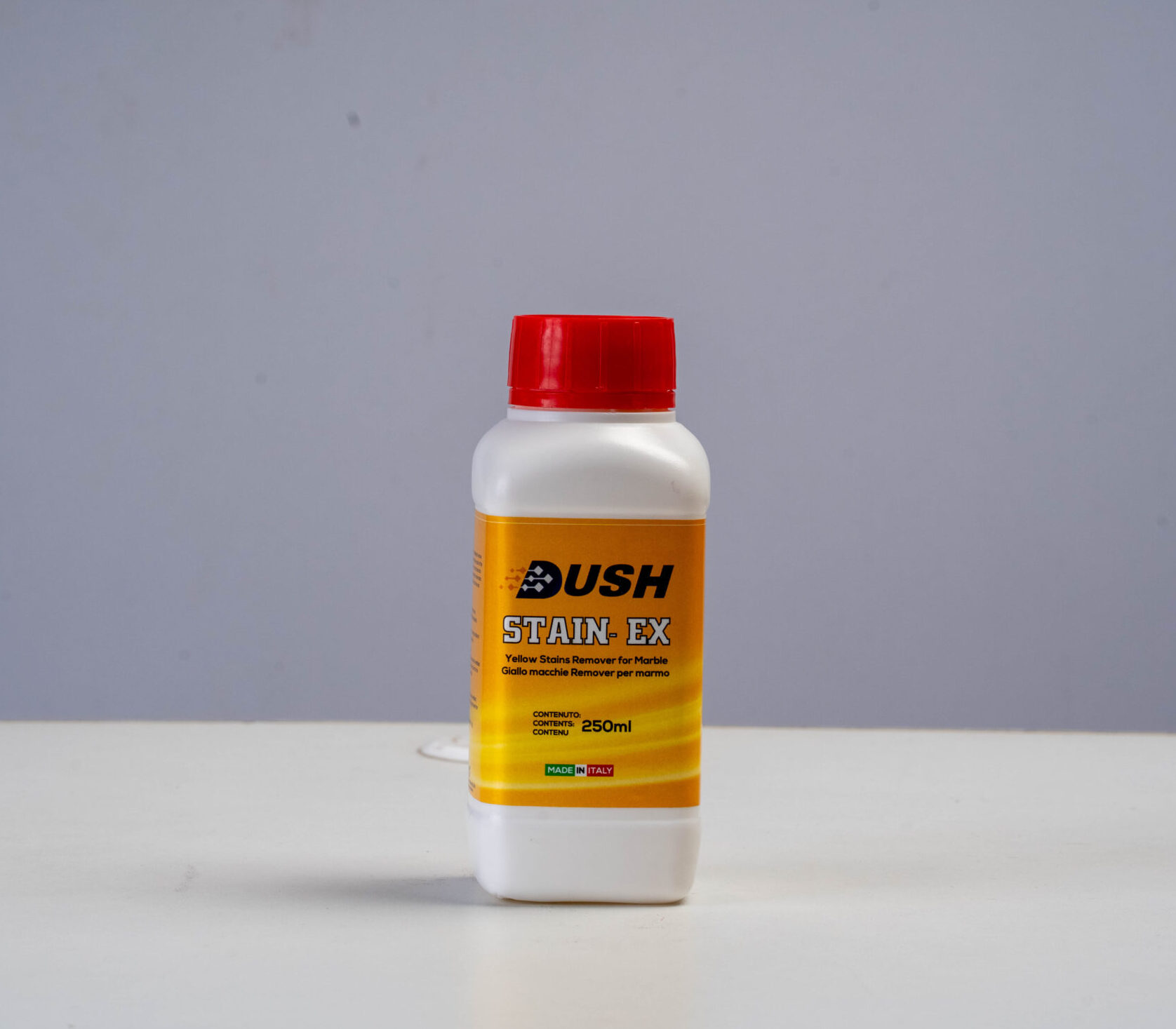
Dush Stain-Ex was developed around the principle that most marble discolouration is recoverable, not permanent — the chemistry targets exactly what causes yellowing without altering or weakening the underlying stone in any way. There is no grinding away of material, no removal of stone, no structural intervention of any kind. The marble that emerges after treatment is the same physical slab that was installed originally, simply restored to its correct colour.
This is fundamentally different from approaches that attempt to mask yellowing with a new coating or topical treatment — Stain-Ex addresses the actual cause sitting inside the pore structure, which is why the result tends to be a genuine restoration of the original colour rather than a covered-up appearance that could shift or fade over time.
- ★No slab removal required: Performed in place on the installed marble — no demolition, no disruption to surrounding flooring
- ★Treats the actual cause: Breaks down oxidised iron and absorbed organic compounds rather than masking discolouration
- ★Works on long-standing yellowing: Effective even on discolouration that has been present for years, with additional application cycles for deeper staining
- ★Safe on polished surfaces: Does not etch or damage the polish when used as directed, preserving the marble's existing finish
- ★Significantly lower cost than replacement: A fraction of the cost, time, and disruption of removing and replacing a slab
How Many Applications Old Yellowing Actually Needs
There is no fixed limit, but most yellowing responds within 1 to 3 applications of Dush Stain-Ex. Very old, decades-old yellowing often requires 3 to 5 applications because the discolouration has had more time to penetrate deeper into the pore structure. Progressive improvement after each cycle is the expected pattern and a positive sign that continued applications will fully resolve the yellowing, rather than a reason to stop.
<1 year
1–2 applications typical
Recent discolouration has not penetrated deeply. Most cases show substantial or complete colour restoration after the first cycle, with a second cycle for full resolution.
1–5 years
2–3 applications typical
Discolouration has settled more deeply. Progressive improvement is visible after each cycle, with most cases fully resolved by the third application.
5+ years
3–5 applications typical
Deepest penetration, requiring the most thorough treatment. Still treatable in the large majority of cases — patience through multiple cycles is the main requirement, not replacement.
If after 4 to 5 applications the discolouration has shown no improvement whatsoever, it is worth having the marble professionally assessed to confirm the cause is genuinely oxidation or organic staining rather than something else — such as a dye originating from the stone's natural mineral composition, which is rare but occasionally occurs in certain marble varieties and behaves differently from typical surface contamination.
Step-by-Step Treatment Process
Confirm the Yellowing Is Treatable
Run your hand over the area. If the surface is smooth and intact with only colour discolouration, the marble is a good candidate for Stain-Ex treatment. Any roughness, pitting, or cracking should be assessed separately first.
Clean the Area Thoroughly
Clean the yellowed marble with a pH-neutral stone cleaner and allow it to dry completely before applying any treatment.
Apply Dush Stain-Ex
Apply Dush Stain-Ex as a 5mm paste over the yellowed area, extending slightly beyond the visible edge of the discolouration.
Seal and Leave for 24 Hours
Cover completely with plastic film, tape the edges to create an airtight seal, and leave undisturbed for a full 24 hours.
Remove and Assess
Remove the plastic and dried poultice with a plastic scraper, clean with water, and assess the colour improvement once fully dry.
Repeat as Needed
For older or deeply set yellowing, repeat the application 2 to 4 more times, with colour typically improving progressively each cycle.
→ Older yellowing needs patience, not replacement
Apply Permanent Prevention
Once the original colour is restored, specify Dush Densi Max Ultra at the next polishing cycle to permanently close the pore structure and prevent yellowing from returning.
Keeping It From Coming Back
After successfully reversing yellowing with Dush Stain-Ex, prevent recurrence by applying Dush Densi Max Ultra penetrating densifier at the next professional polishing cycle. This permanently closes the marble's internal pore structure, eliminating the pathway oil, moisture, and other contaminants use to cause yellowing in the first place — restoring the colour is only half the solution without also addressing why it happened.
The cycle that causes yellowing — open pores allowing oil and moisture to penetrate, oxidation occurring slowly inside the stone over years — repeats indefinitely unless the underlying pore structure is closed. Dush Densi Max Ultra, applied at the 80-grit grinding stage, chemically reacts with the calcium minerals inside the marble's pores and forms a permanent hydrophobic matrix — closing the pathway permanently rather than treating each new instance of yellowing as it appears.
See Whether Your Yellowed Marble Is Treatable
Send a piece of your affected marble to Dush, or arrange an on-site assessment. We can give you an honest evaluation of whether treatment will fully restore the colour before you consider any other option.
View Dush Stain-Ex →Related Dush Guides and Products
Marble Yellowing Reversal — Questions Answered
Can yellowing on marble be reversed without replacing the slab?
When is slab replacement actually necessary instead of treatment?
How many times can Dush Stain-Ex be applied before giving up on a stain?
Does old, decades-old yellowing respond to treatment the same way as recent yellowing?
Is it cheaper to treat yellowed marble or replace the slab?
Will treated marble look exactly the same as it did when new?
External References
Restore Your Marble — Don't Replace It
Dush Stain-Ex reverses yellowing where it lives — inside the pore structure — without removing a single piece of stone. Most yellowed marble is fully treatable.


Comments
Post a Comment